Book One · The dichotomy of control · Out now
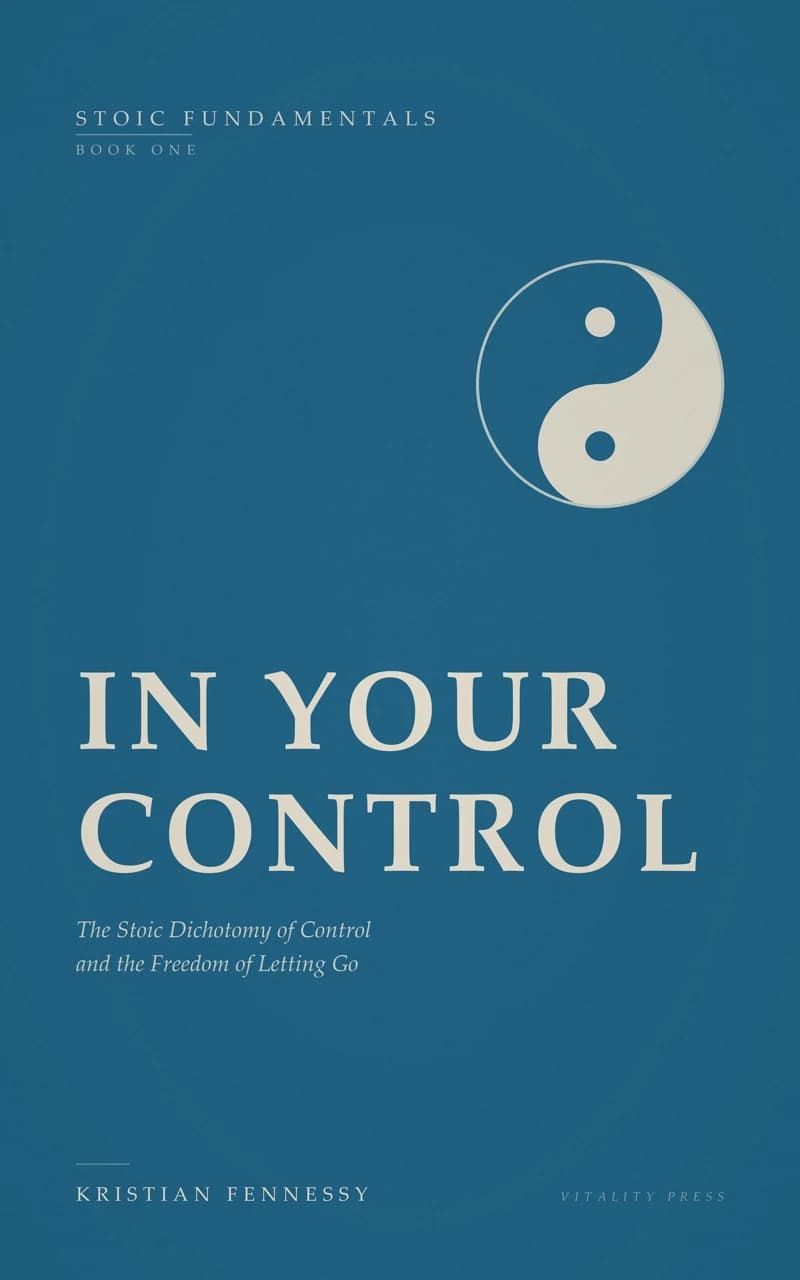
In Your Control
The Stoic Dichotomy of Control and the Freedom of Letting Go
“Focus on what you can control” — finally explained well enough to use.
You have heard it a hundred times — focus on what you can control — and you have never once quite managed to do it. That is not a failure of discipline. The idea has been cut down into a slogan small enough to fit on a mug, and everything that made it useful was trimmed off to make it fit.
The slogan works on a slow elevator. It abandons you exactly where you needed it: at the diagnosis, the grief, the unanswered message, the person you love walking toward a cliff you can see and they cannot.
In Your Control takes the idea seriously enough to follow it all the way down. It is a whole book on a single concept — the dichotomy of control, Epictetus’s distinction between what is up to us and what is not. One idea, in depth, sourced to the Stoics’ own words, and turned into something you can do.
Of things, some are in our power and others not. In our power are opinion, pursuit, desire, aversion, and, in one word, whatever are our own actions. Not in our power are body, property, reputation, command, and, in one word, whatever are not our own actions.
Inside, in three parts
- Part One
The Idea
What the dichotomy of control actually is, what falls on each side, and why we reliably get it backward.
- Part Two
The Hard Cases
The idea tested where it genuinely hurts: other people, those you love, the body, outcomes, the anxious future, the unfixable past, the noise of the world, and grief — where the book is honest about the limits of what any philosophy can do.
- Part Three
Living It
The small, real Stoic practices that turn insight into a way of living: the morning and evening bookends, the pause before you react, the retraining of desire, and amor fati.
What you will take away
- What Epictetus actually distinguished — and why “control” is a modern word for it that quietly misleads.
- The two-part sort you can run in any moment of distress, in about four seconds.
- Why the slogan collapses at the hard edges, and what the Stoics said to do there instead.
- How to want things without being ruled by whether you get them — the discipline of desire.
- The reserve clause: how to plan and act wholeheartedly while staying unbroken by the outcome.
- What to do about other people, who are never in your power and never stop mattering.
- Where the idea genuinely reaches its limit — grief — and what honesty requires there.
Pick it up if
Anyone who keeps bumping into “focus on what you can control” and wants to understand and use it — usually arriving through anxiety, a loss, a hard relationship, or plain curiosity. No philosophy background assumed.
Skip it if
Readers wanting a broad survey of Stoicism, an academic treatise, a workplace manual, or quick life-hacks.
Read the idea first, free
The whole of the dichotomy of control is explained on this site — including the misreadings and the place it reaches its limit. If the explainer is useful, the book is the same thing at depth.